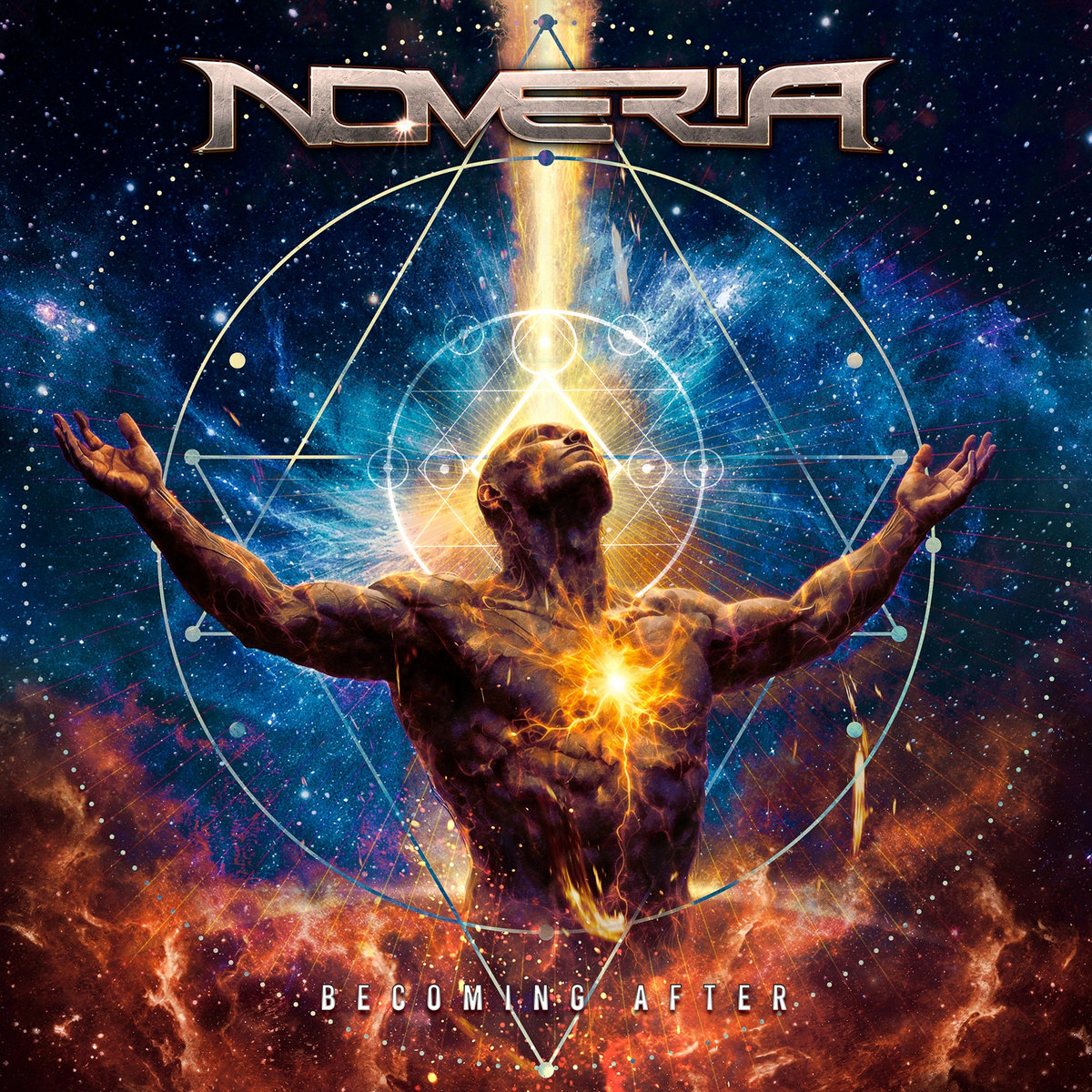
Noveria – Becoming After
Release Date: 21st August 2026
Label: Scarlet Records
Bandcamp
Genre: Progressive Power Metal
FFO: Dream Theater, Labyrinth, Kamelot, Symphony X, Nevermore, later Evergrey.
Review By: Malte Brigge
Since 2013, Rome’s Noveria have been mixing and matching different elements of power and prog to find their own lane in a pretty crowded scene. From 2014’s Risen to their new release, Becoming After, they have incrementally added elements to their sound to evolve from a guitar-heavy riff-oriented band to being almost fully symphonic. Becoming After picks up where 2023’s The Gates of the Underworld leaves off, despite having replaced sixty percent of the band earlier this year. For their fifth offering, what shiny new sounds does this shiny new lineup bring to the awaiting ear?
Becoming After leads off with a Kamelot-koded MENA melisma that has nothing to do with anything else on the album and sets up an all-hands-on-deck explosion of heavy, choppy guitars, syncopated drumming and stringed orchestration. It’s wildly active and serves as a strict template for nearly every song on the album: quick introductory measure, musical explosion, verse-pre/chorus-verse-pre/chorus-bridge-solos-chorus-outro. Six of the nine songs (the tenth track is a short instrumental outro) follow the template so precisely they barely even differ in length. The only things that really change are whether the guitar or synth takes the first solo, and if the outro follows a repeated verse or chorus. Individually, some songs are pretty good, but as a whole, the songwriting gets stale quickly. Combined with a DR7 production that pushes way past the ceiling, you end up more with a long plateau than an exciting series of peaks.
Francesco Marino is a newcomer on vocals, replacing Francesco Corigliano in more than just name: I did a Noveria discog run and didn’t realize Becoming After had a different singer until I read the promo material. What Marino adds, and I wish added more, is a solid, Amorphis-y death growl at choice moments on Cold Flames (featuring Mistheria) and Heavenfall. He’s got a soaring power metal tenor that follows the phrasings and lifts of mid-90s James LaBrie, and that’s just the start of Dream Theater comparisons. A lot of Francesco Mattei’s riffs and solos show a close study of Petrucci’s technique and sound, and the heaviness of their palm-muted, open-string chugging, their shifting time signatures and off-beat rhythms, and a soaring smoothness in transitions gives you something of a simplified cross between Nevermore and Dream Theater. They imitate their inspirations a little too well: no matter how many times I listen to Becoming After, only a general sense of its sound ever sticks. In fact, I inevitably get the final suites of “A Change of Seasons” stuck in my head. It’s not great when your music does more to recall your influences than your own sound.
The most interesting track is the closing title track, which is a two-minute orchestral instrumental with some operatic vocals. Part of what makes it interesting is just that it’s different from everything else. Abigail Stahlschmidt and Luca Basile do an excellent job with string arrangements and performances throughout the album, though I wish the mixing made them more prominent in places. The Viper’s Nest and Cold Flames, album centerpieces and standouts, dabble in some electro-industrial moments, but not long enough to be pertinent. Infinite Horizons opens with a cool, choppy, orchestral piece that plays no role in the song proper. Noveria seems always on the verge of doing something really interesting before falling back into their palm-muted ABAB safe zone. Three ballad-esque songs close out the album (not counting the instrumental outro), and I wish they didn’t. Through Your Light (featuring Mike Moran) has Myung-level cringeworthy lyrics and feels more like an exercise in cliché than a meaningful experience. Heavenfall almost redeems the back half, but by this point it’s impossible to distinguish from anything that hasn’t already been performed.
Becoming After is fun while it plays and easy to forget when it’s over. Noveria doesn’t really do anything wrong, but they also don’t do much that matters. The emotional sweep of the album is more about the concept of emotion than any actual feelings, which leaves the experience rather hollow. There’s nothing here that I haven’t heard elsewhere and, if I’m being honest, that I wouldn’t rather hear elsewhere. If they could lean more into an identity of their own—develop the growls, give space to the violins, let riffs breathe, write more than one type of song—I’d be much more engaged with their trajectory. As it is, I can’t see myself returning to Becoming After, and I have pretty mixed feelings about what Noveria does next.
 (2.5 / 5)

