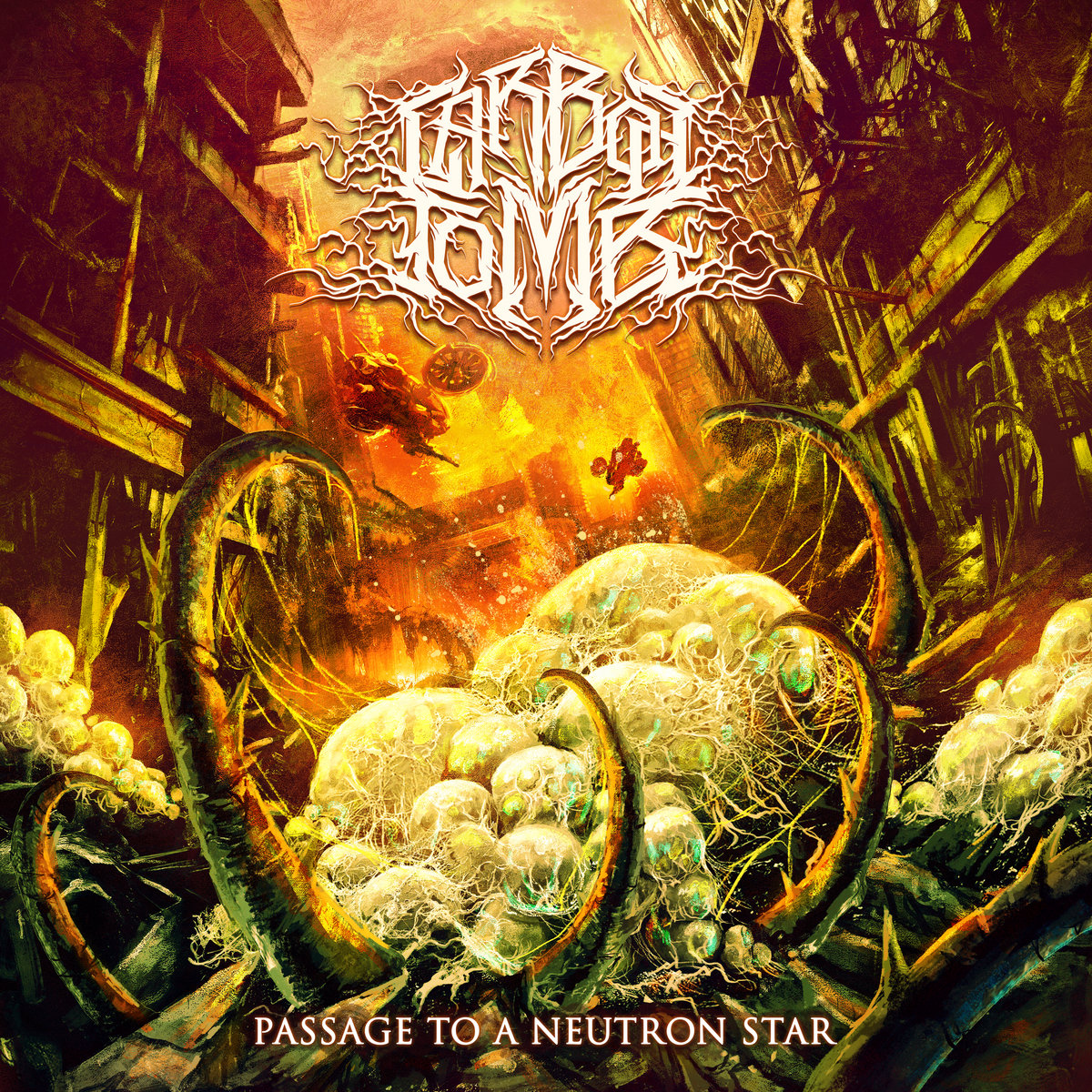
Carbon Tomb – Passage to a Neutron Star
Release Date: 17th July 2026
Label: Transcending Obscurity Records
Bandcamp
Genre: Dissonant Death Metal
FFO: Ulcerate, Dysgnostic, Devenial Verdict, Elitist, Artificial Brain, Mors Verum, Suffering Hour.
Review By: Malte Brigge
Between late May and this week’s release of Carbon Tomb’s Passage to a Neutron Star, bands associated with members of Denmark’s spidery Dysgnostic have released four albums. Richardt Olsen features on three of them, providing drums for Dysgnostic and Genocidal Doctrine while playing guitar and providing blackened shrieks for Carbon Tomb. Olsen seems to be flowing with a creativity of a very different sort than your average Rogga. While Carbon Tomb’s only other release, a self-titled EP from 2023, has a slightly slanted approach to mid-range death metal, Passage to a Neutron Star takes cues from the worminess of Gorguts, the emotional emptiness of Ulcerate, the structural heft of Devenial Verdict and the squiggly, vibratory elements of Mors Verum, to create a chromatic, scratchy listening experience just adjacent to comfortable.
Gnarly, twisted, knotty riffs and tremulous, insectoid pathways burrow through these thirty-four tightly packed minutes. You’ll recognize Dysgnostic’s disjunction, but Carbon Tomb nails songs down with more developed hooks and aggressive attacks, burying its spatial roots in Death’s Symbolic-era and echoing the structural grittiness of Crown of Madness. Passage to a Neutron Star is discordant but not as disharmonic as End Whispers, slippery but not as stomach-churning as Gorguts. Jeppe’s deep growls tunnel through the album, serving as a steady constant against Richardt’s flaying guitar work and Mikael’s wild drumming. Richardt’s barking shrieks create strange harmonies with Jeppe’s low roars, sometimes creating freakish hybrid phrasings. Mikael’s snare has a strong snap to it that varies across the album, from a trash-can-lid crunch on From the Giant’s Snout to a ringing pong on Tritons of Ichthyology to a powerful, resonant thud on grindy drag racer Gogoffmagog. More than once I tuned out the rest of the music just to marvel at his sublime stickwork.
Richardt’s clean, ominous picking on opener Chanting Spells I (with no sign of II anywhere) establishes the inverted tones that crawl across the album. His riffwork is powerful and memorable, demonstrating technical prowess (A Hidden Creature) and thick muscle (Reversed Head Renewal). Tremolo runs morph into lead melodies but never more meaningfully than on Of God’s Neglect, where it rises out of the miasmatic guitar work to harmonize with a stunning soprano vocal drone that hangs over the song like a deadly angel surveying a smoldering battlefield. No credits inform me who this devastating voice belongs to, but she soars while Jeppe’s voice gurgles deeper into the monstrous. The chord formations on Of God’s Neglect are beautiful but compact, like the air of an incoming storm, with Jeppe’s bass thugging through a mid-song opening and Richardt’s lead work feeling weirdly painful, highlighting the despair and haunting absence at the heart of it.
Songs revolve around clear, recognizable structures without ever feeling repetitive. Moments on Of God’s Neglect and Reversed Head Renewal hang over a chasm before the tension breaks to re-establish gravelly foundations. The skewed riffing and weird symmetry on A Hidden Creature or the alien blast attack of the closing title track create not just dis-ease but have jagged formations that shun emotional direction and spread the listening experience apart, approaching but not quite giving into panic. Open voids air out claustrophobic experiences that threaten to collapse beneath the weight of the harmonic friction. No time is wasted as the album lurches from atonal counterpoints to thagomizing grooves (From the Giant’s Snout, The Dog Hunter), from triangular tone clusters (The Dog Hunter) to straightforward destruction (Gogoffmagog, Tritons of Ichthyology). Even at its simplest, there’s no feeling of simplicity as clever time shifts keep you disoriented and deceptively slow BPMs are sliced into violent subdivisions. It never cedes atmospheric elements to the vacuum at its center, which spirals everything into a complex but navigable cosmic dance.
I started listening to A Passage to a Neutron Star before I knew I was going to review it, and already had a hard time turning away. It kept showing up in my rotation and kept holding my attention. Its excellence is easy to recognize while its complexity makes it impossible to set aside as a casual listen. It doesn’t demand your attention so much as draws it in, the way black holes feed off the information of nearby stars. It’s a weird, hyperactive album full of unsettling surprises, unmentionable horrors and haunting passages. Look for it on year-end lists, because that’s where it’s headed.
 (4.5 / 5)

