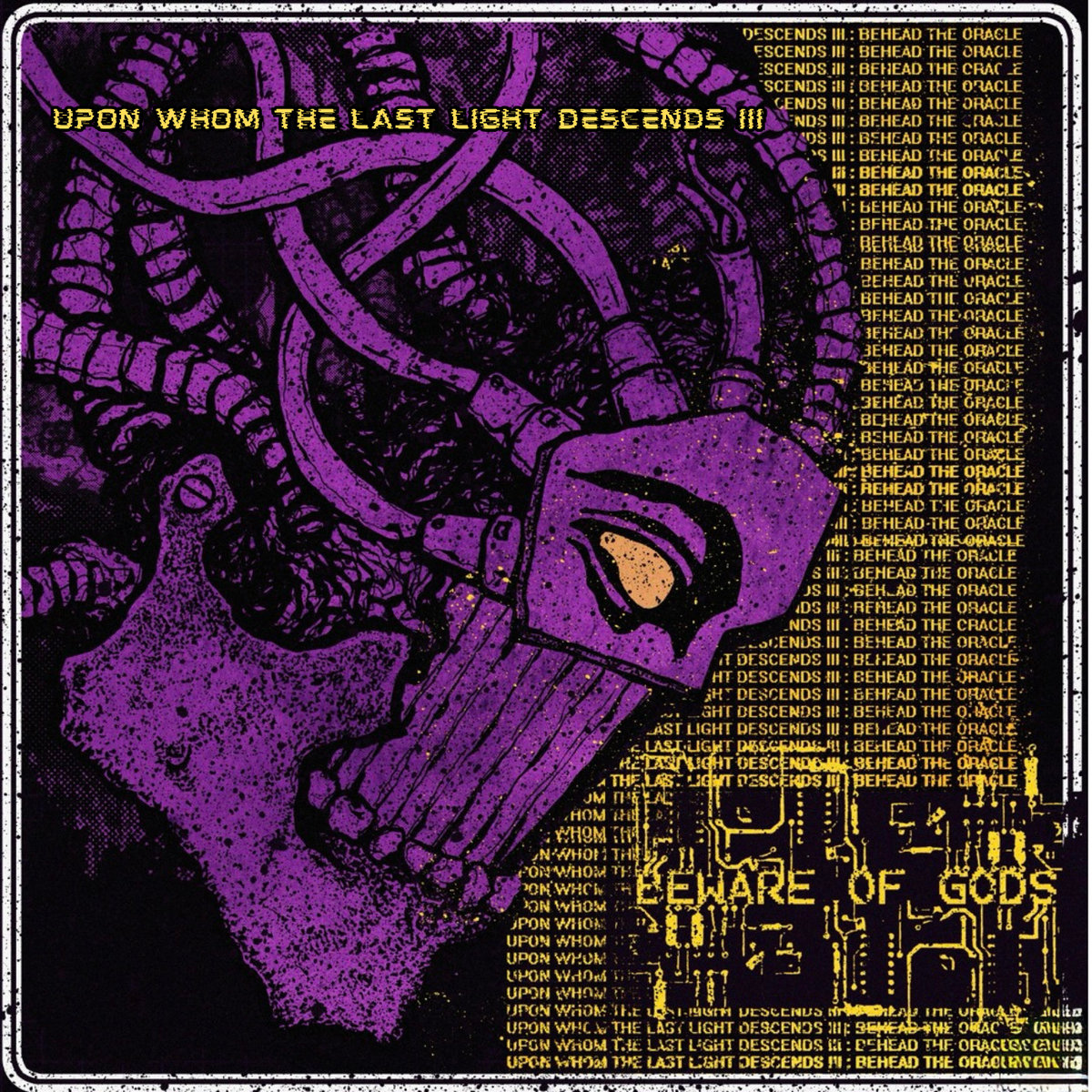
Beware of Gods – Upon Whom The Last Descends III: Behead the Oracle
Release Date: 10th July 2026
Label: Invoke Records
Bandcamp
Genre: Doom Metal, Industrial Metal, Post-Metal.
FFO: Dvne, Psychonaut, Rosetta.
Review By: Jeff Finch
Beware Of Gods isn’t the kind of band you casually throw on in the background. Behead The Oracle is clearly designed to be experienced as part of a much larger narrative, one built around cosmic horror, industrial decay, and philosophical themes. Reality with a dose of Cthulhu, anyone? It’s an ambitious concept, and after spending time with the album, it’s obvious that every sonic decision feeds into an overarching mythology. Whether every decision works as a listening experience is another matter.
The album’s biggest strengths are the riffs and the vocal performance. The guitar work is absolutely crushing, leaning into massive doom-laden grooves while still finding enough variety to keep things engaging. There are several moments where the riffs feel downright colossal, carrying the kind of weight you’d expect from a project rooted in both doom metal and industrial music. They’re memorable, heavy, and often the driving force behind the album’s best material.
The harsh vocals are equally impressive. They’re commanding without feeling one-dimensional, delivering just the right amount of grit and conviction to sell the record’s themes of collapse, conflict, and rebirth. Even without diving into the lore, the vocal performance conveys a sense of urgency and desperation that fits the dystopian atmosphere exceptionally well.
Where Behead The Oracle becomes more challenging is in its more avant-garde passages. Throughout the record, Beware Of Gods frequently shifts away from traditional song structures in favor of cinematic interludes, abstract sound design, industrial textures, and experimental transitions that seem intended to immerse the listener in its fractured universe. From a conceptual standpoint, I understand exactly what these moments are accomplishing. They help build the mythology and reinforce the feeling that you’re listening to a transmission from a dying civilization rather than simply another doom metal album.
The problem, at least for me, is that understanding their purpose doesn’t always make the album enjoyable. Those experimental detours repeatedly interrupt the momentum established by the album’s strongest songs. Just as the record settles into a massive riff or particularly memorable vocal passage, often a great combination of both, it often pivots into something more atmospheric or abstract, breaking the flow in a way that kept me from fully sinking into the experience. Rather than enhancing the heavier tracks, those moments occasionally feel like speed bumps between them.
That isn’t to say the experimentation lacks merit. Quite the opposite, it’s refreshing to hear a band commit so completely to a creative vision instead of chasing accessibility. The world built feels fully realized, and there’s a clear sense of purpose behind every layer, every pulse, and every unsettling transition. This isn’t experimentation for its own sake; it’s storytelling through sound. I simply found myself wishing that the narrative ambition and the musical pacing were a little more tightly aligned.
When Behead The Oracle is firing on all cylinders, it’s genuinely impressive. The combination of monolithic riffs, punishing vocals, and oppressive atmosphere creates moments that feel enormous, more than enough to keep me interested in where Beware Of Gods takes this mythology next, even if I wasn’t completely sold on every artistic choice made along the way.
Ultimately, Behead The Oracle is an album I respect a little more than I outright enjoy. Its ambition is undeniable, its performances are strong, and its conceptual depth gives it an identity all its own. At the same time, the pacing never quite allows its best moments to have the sustained impact they deserve. For listeners who enjoy immersive, lore-heavy albums that prioritize atmosphere as much as songwriting, this could easily become a favorite. For me, the riffs and vocals are what keep bringing me back, even if the more experimental passages prevent the album from reaching the same heights as its strongest individual moments.
 (3.5 / 5)

