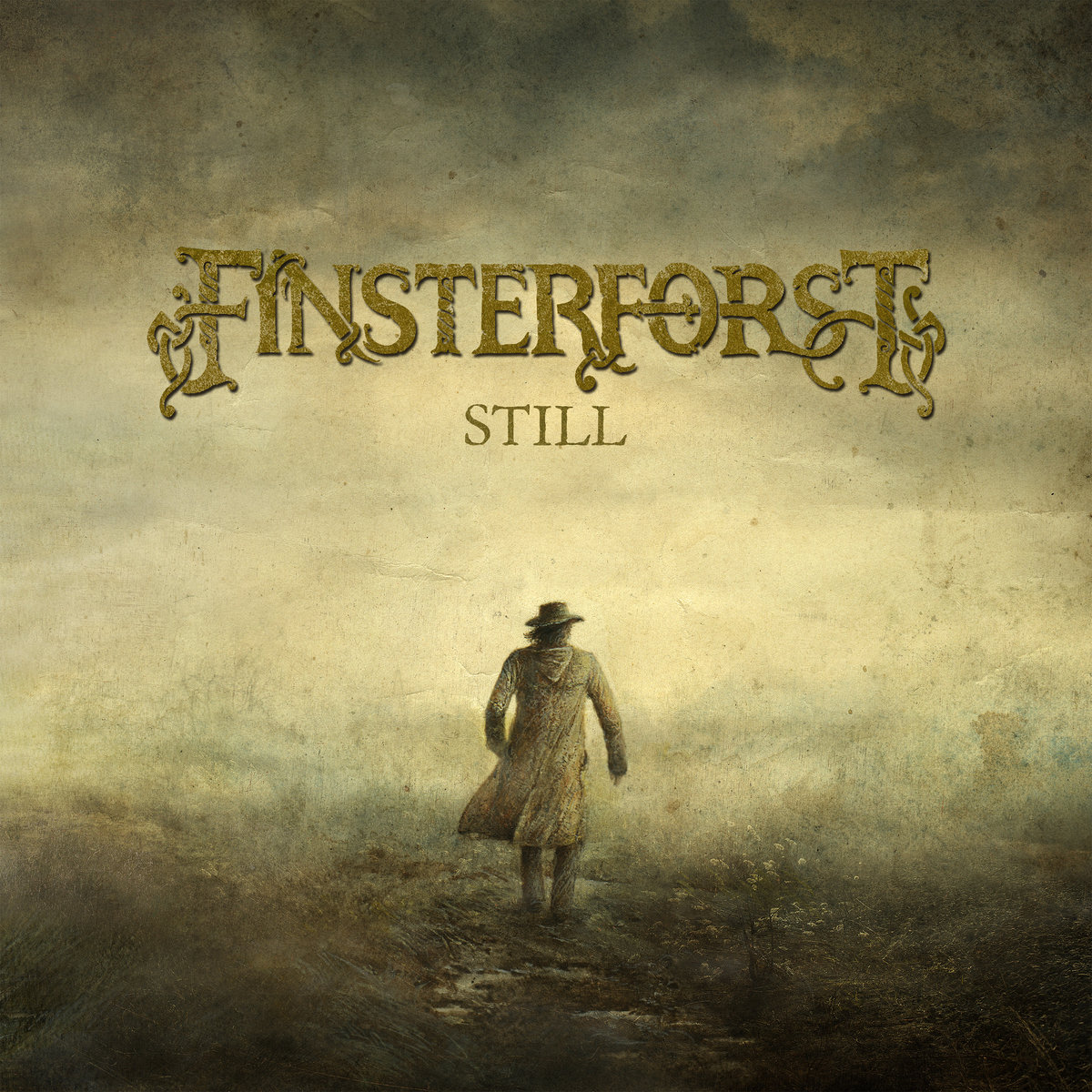
Finsterforst – Still
Release Date: 31st July 2026
Label: AOP Records
Bandcamp
Genre: Folk/Viking Metal, Black Forest Metal.
FFO: Amorphis, Falkenbach, Vintersorg, Thyrfing, Kromlek, Primordial.
Review By: Malte Brigge
Elyon of Clan Franks threatened me with Bloodfeud if I didn’t listen to Finsterforst’s 2023’s “mini-album” Jenseits, whose forty-minute, four-suite song became an instant buy. There’s so much to listen to it never occurred to me to explore more of the band’s catalogue until the opportunity to review their new album, Still, arrived. Finsterforst ply a slightly charred longform folkish metal they call, appropriately, “Black Forest Metal”, big on atmosphere and bigger on epic swell. There’s a sense of second-wave Amorphis in their polished interplay between emotive, sing-along moments and crisp, aggressive attacks while staying in an open mid-range suitable for exploration. Falkenbach’s European paganism weaves through their folk melodies beneath shades of Vintersorg’s expansive structuring. There’s flashes of Primordial’s dark, theatrical intensity and Thyrfing’s lead-heavy stomps without the brooding grittiness. Finsterfrost combines such elements behind a multi-vocal presentation designed to catch and hold the listener.
Songs are led by the shovel-scraping, blacksoil harsh vocals of Olli Berlin and the mighty bellows of his clean, Horn-of-Helm-Hammerhand baritone. Accordionist Johannes Joseph has returned to the fold full-time, lending his lyric baritone as counterpoint. Together, they blend the mournful with the uplifting, trading parts to signal various emotional shifts (Obduktion) or harmonizing to emphasize collective reflection (Herbstwanderung, Stille Nacht, Fels). Shanty Peter und die Badweihermatrosengewerkschaftskapelle paint big scenery and thicken refrains in a manner reminiscent of Manowar’s “The Crown and the Ring”. Both Berlin and Joseph attack their vocal lines with passion and intensity, often frying out cleans as they push into angry phrasings (Stille Nacht) or creating harmonic moments you could sing along to late at night in Heorot (Herbstwanderung) while remembering lost friends’ mighty deeds. The switch between the two clean voices, the sooty harsh vox, the gang vocal refrains and the choral uplift is the beating heart of Still, through which the structuring of songs is understood.
Joseph’s accordion is far less present than I had anticipated, especially compared to earlier albums. Delightful, well-placed solos on Leere and Obduktion keep its presence meaningful rather than gimmicky, and its delicate use on the bridge of Im Wind is lovely. The sharp synth solo on Obduktion took me by surprise, but, again, Finsterforst shows restraint, using Sebastian Scherrer’s keyboards sparingly, adding brooding effects (Im Wind) or sci-fi atmospherics (Knie nieder), but mostly creating spacious horizons against which Simon Käflein and David Schuldis’ sawtoothed guitars are set. Their work is more chordal than riff-oriented, occasionally sliding into tremolo runs or tight pedal tones, and their melodic solos are often understated. On Leere, especially, you can hear the David Gilmour influence in the way they rise above but don’t break free of the song. Musically, Still may be Finsterforst’s most straightforward album, the instrumentation being relatively sparse and tastefully presented. There’s less emphasis on trope and far more on mood, making for a strong listening experience that sometimes achieves the epic weight the writing strives for.
This weight is supported by Finsterforst’s trademark horns, introduced at strategic moments in nearly every song, signalling sweeps into the majestic. Whether the song is four or twenty-four minutes, the horns carry ambulations into swelling, Valhallaward flights. As much as I like the songwriting, though, I don’t always find the resolutions satisfying. Finsterforst has a tendency to lift and hold until the potency of the moment is lost, sometimes lacking that necessary climactic break and tension release. The twenty-plus minutes of Leere features several crescendos, one nearly five minutes long, burying subtlety, like the breath-catching Mistur-esque flow near the fifteen-minute mark. Songs are enjoyable, the horns are thunderously effective, but too much sustain reduces substance.
I haven’t listened to Still as much as I wanted to because of the prohibitive seventy-eight-minute runtime, fourteen of which are covers—not as bonus tracks but album closers. While the excellent cover of Immortal’s “Beyond the North Waves” suits Finsterforst’s sound and Still’s structure, “Another Brick in the Wall, pt. 2” is too iconic a song, too married to its original context to be meaningful. Sixty-six minutes of original music, with a lack of truly standout passages, overwhelms the experience. The music is powerful, the vocals are strong and it maintains a stoic feeling of overcoming and perseverance. I wish the band persevered a little more in editing and guarded more fiercely those dramatic moments that make their music fun to listen to.
 (3 / 5)

