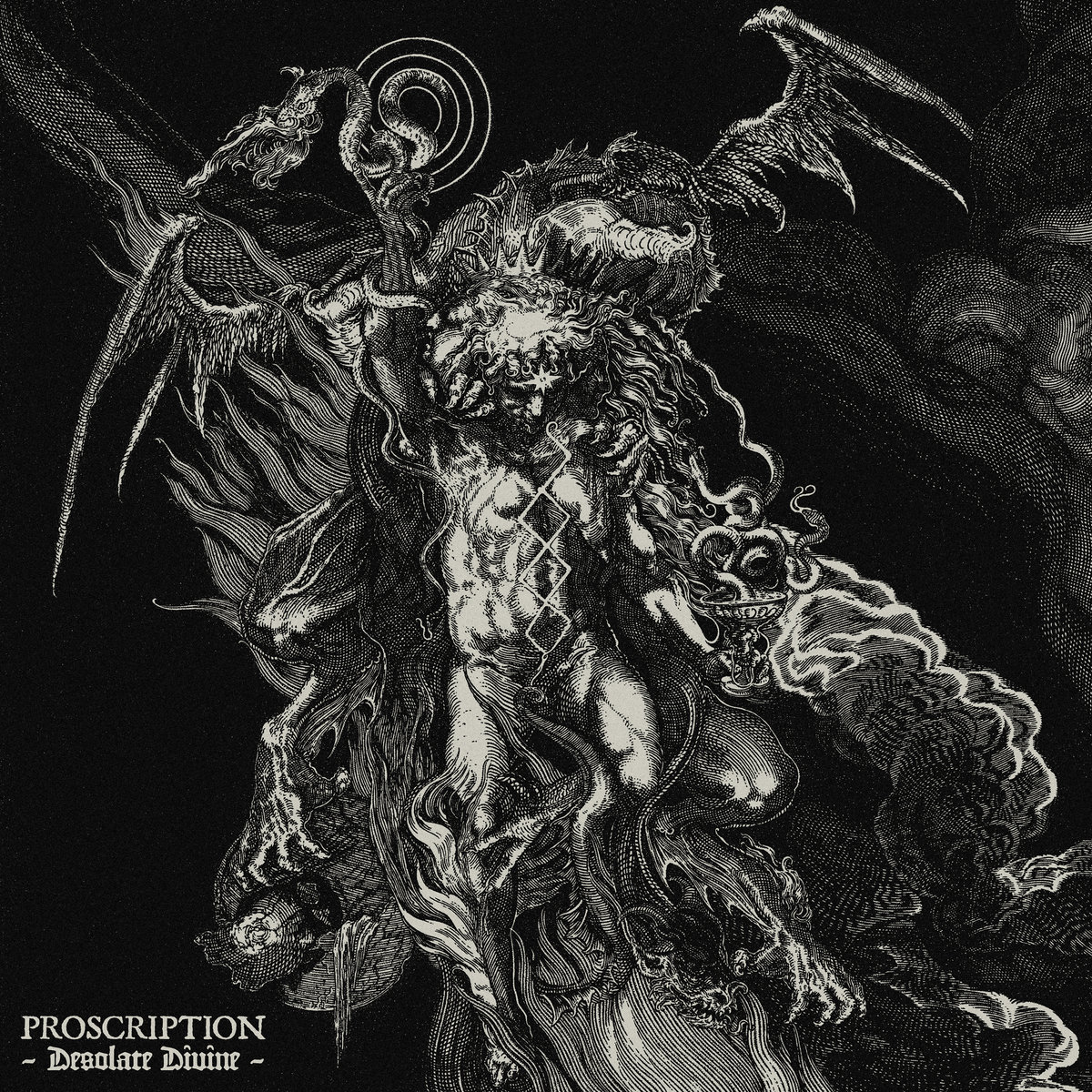
Proscription – Desolate Divine
Release Date: 29th August 2025
Label: Dark Descent Records
Bandcamp
Genre: Blackened Death Metal
FFO: Maveth, Behemoth, Panzerchrist, Ulcerate, Immolation.
Review By: Malte Brigge
Proscription’s 2020 debut, Conduit, fletcherized its unsuspecting audience and stuffed their remains with short-fuse dynamite. Led by ChristButcher, Conduit was a direct follow-up to his other band Maveth’s sole release, 2012’s Coils of the Black Earth; playing them back to back, you have to look closely to see where one ends and the other begins. ChristButcher wrote much of Conduit before fully forming his new band; in composing sophomore release, Desolate Divine, he “had a much better understanding of what Proscription had become and where to go”. With a (mostly) solid line-up and five years of development, is Desolate Divine simply the third of a trilogy or the start of a new Proscriptionverse?
Press play on Desolate Divine at your own risk. There is no warning, no atmospheric introduction, no interest in mood nor your auditory health. Murdersaw guitars, brainmelting drums and dark alley bass assault every sense, seeking to induce whiplash, pinched nerves, broken bones, torn muscles—any pain possible. ChristButcher’s unholy death roar reaches into the seventh circle of hell to call on fiends who, via bassist Apep, respond with blackened howls made of dust, ashes and vomit. They trade lines like crooners and often do whatever the death metal equivalence of harmonizing is, building a caterwauling torture chamber where pain goes to thrive. They aren’t as distinct a duo as Panzerfaust’s Goliath and Kaizer, but their pairing on Desolate Divine gives Proscription an identity that wasn’t as pronounced on Conduit.
Opening track Gleam of the Morning Star employs brevity to serve notice what the next 39 minutes of your life will be like, prostrate before the altars carved by Morbid Angel and Immolation in a church charred by the blackened fury that stretches from Mayhem and Darkthrone to Behemoth and Belphegor. There’s nearly no break before Bleed the Whore Again screams forth, all hands on deck, full speed ahead, no looking back. Each of the first seven songs pretty much picks up where the previous one leaves off, scaly imbricate tremolos morphing one to the next, guitarists Cruciatus and ChristButcher somehow keeping up with each other. M.K.’s drumming is to be both admired and feared. Those sparse moments when he pauses feel like you’re surfacing for a desperate gasp of air—all you get is a few seconds in Entreaty of the Very End and Behold a Phosphorescent Dawn before you’re plunged back in. So little time is wasted on this album that Heave Ho Ye Igneous Leviathan and Desolate Divine sound like they start in medias res, so brutishly energetic they’ve already taken off before you’ve started listening.
Songs advance with little resembling verses or refrains. Any repetition of an idea rarely occurs with the same rhythm, riff or vocal pattern. The album, built largely in the middle guitar range, whips so unceasingly past that distinctions are difficult to come by, yet there is little repetition and absolutely zero pause for reflection. Only the penultimate track and final actual song, The Great Deceiver, stands slightly apart, opening with an almost friendly riff in a slower tempo. It takes longer to shift into the axis-shuddering gears you’re by now familiar with, and even the vocalists take a rare minute off before lashing out. It hosts the album’s one real guitar solo, devoting the final two haunting minutes to crying and screaming and calling out to a god that just. isn’t. there. It feels like the song was written specifically for Cruciatus—who has since left the band—to soar. No matter how distracted I am when playing this album, this part always arrests my attention, and may be one of 2025’s finer guitar moments. Two minutes of melancholic drone (entitled Not but Dust, and should I presume they mean “nought”?) close the album out by reminding you there’s nowhere to arrive and no one waiting when you get there. It isn’t necessary, but it works to create that sense of finality.
Desolate Divine observes the wasteland and lays waste to it. It asks, “How unrelenting can you be?” and then finds out. Every sharp object you can think of—claws, fangs, battle jacket spikes, assassin’s daggers, obsidian—is hurled without mercy at the audience. It might not have much internal variety, but it cuts through pain with more pain in the form of tight, technical playing and hellfire songwriting. There’s a lot of “heh, that was cool” moments, not dissimilar to watching a volcano continuously explode. Keep a safe distance but don’t take your eyes off this one.
 (4 / 5)

