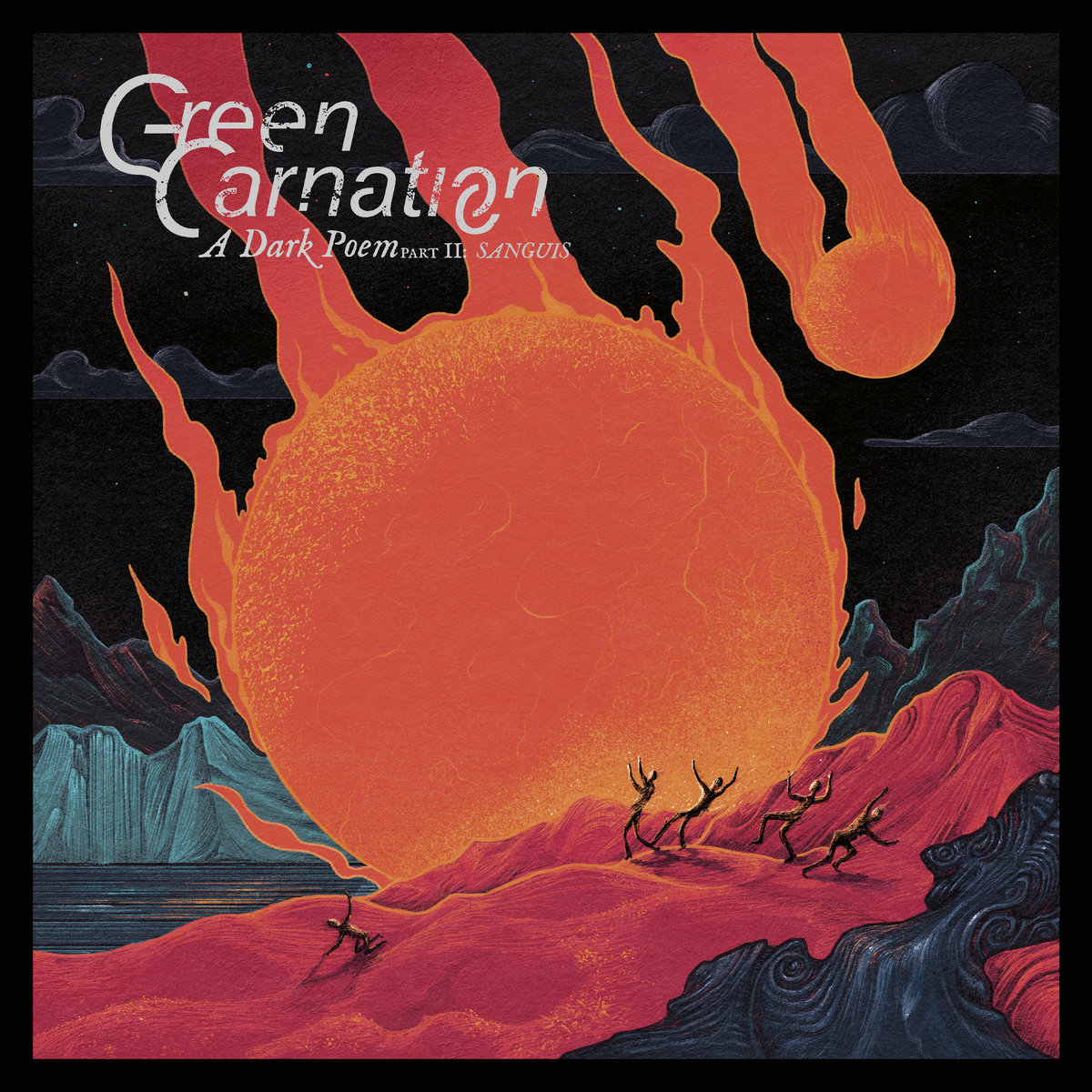
Green Carnation – A Dark Poem, Part II: Sanguis
Release Date: 3rd April 2026
Label: Season of Mist
Bandcamp
Genre: Progressive Rock/Metal
FFO: Devin Townsend, Leprous, Opeth, Paradise Lost, Enslaved, Queensrÿche.
Review By: Magnus Rotås
Founded in the early ‘90s by Emperor’s original bassist Tchort, Norwegian prog-metal band Green Carnation have never been a band to take the obvious route. In preparation for this review, I took it upon myself to listen to all of Green Carnation’s albums. I was instantly reminded of how it is undoubtedly their sophomore release, Light of Day, Day of Darkness, that is the band’s masterpiece – a really dark one-song concept album lasting for a whole hour. And as the album covers got worse over the years, the music always stayed relatively solid. Then you’ve also got The Acoustic Verses, which stripped away almost everything and is a completely acoustic album. After that, the band went on hiatus for 14 years before they came back swinging with Leaves of Yesteryear. In other words, this is a band that is not shy when it comes to ambitious concept albums, which brings us to the Dark Poem trilogy, and it might be their most ambitious project yet.
The idea for an album trilogy penned after Shakespeare’s tragic Ophelia certainly is something that could go either way, but last year’s Pt. I: The Shores of Melancholia showed that the band was serious, and I really liked it. It was all guns blazing, with some very memorable and instantly enjoyable songs. The idea for part two, however, was to go deeper and darker both musically and lyrically. “The second part of A Dark Poem holds some of the most personal lyrics that I’ve ever written,” says Stein Roger Sordal, the band’s bassist and primary lyricist. “The lyrics are so personal that I had to go many rounds with myself over whether or not to tone them down. In the end, I chose to keep them as honest as possible”.
Green Carnation is not the kind of prog metal that’s about crazy solo’s, endless noodling on the guitar or flashy technicality. It’s a much more low-key prog, focusing more on atmosphere and conveying and reflecting the lyrical themes with the music.
The title track Sanguis unfolds across nine minutes of slow-burning tension, pairing cresting clean passages and Hammond organ swells with a doomy undercurrent that feels almost suffocating. It’s here that the album’s central thesis emerges: this is Green Carnation at their most exposed. The narrative of familial trauma and reluctant understanding is not dressed up in metaphor—it bleeds openly and uncomfortably, setting the tone for everything that follows.
Loneliness Untold, Loneliness Unfold is perhaps the most striking moment here—not because it’s the heaviest, but because it strips everything back and feels very intimate and vulnerable. The track is fairly straightforward, and part of me wishes it could have progressed a bit more into different parts like Metallica’s Fade to Black, but it’s still a nice little track.
Tracks like Sweet to the Point of Bitter and I Am Time carry the album’s more immediate hooks, balancing muscular riffs with melodic sensibility. They are the two heaviest tracks on the album, yet there’s a quiet confidence in these songs—they are less about overwhelming the listener, and more about letting the themes settle and resonate. I think it would be cool if they got Grutle Kjellson from Enslaved to come back and do some vocals on Sweet to the Point of Bitter, like they did for The Slave That You Are on part I, the track would certainly suit it. I Am Time stands out with its winding solo and reflective lyrics capturing the album’s fixation on perspective and hindsight. It’s emblematic of Sanguis as a whole: thoughtful, layered, and patient.
Fire in Ice is the track I keep thinking to myself is the weakest on the album, but then every time I hear it, it surprises me how good it is. It has this really cool synth harmony with the guitars and perhaps one of the best vocal hooks on the album.
Closing track Lunar Tale offers a different kind of resolution—if it can be called that. With its delicate piano and Ingrid Ose’s understated flute, it provides a moment of fragile beauty, though one tinged with unease. Rather than offering closure, it leaves the listener suspended, drifting off into the void, staring into whatever darkness Part III might bring. That ending is so haunting; it left me just staring out into the air for a minute before I snapped back to reality.
Sanguis is an album that can only get better with time. Digging deeper into the lyrics and themes will certainly enhance the experience. As a standalone album, Sanguis might feel less immediate than its predecessor; it’s certainly no popcorn album with little to offer of quick entertainment (for that I would rather recommend part I). But that’s precisely its strength. This is not meant to eclipse Part I—it’s meant to complete it, to complicate it, and to push the narrative into deeper, more human territory. In the context of the trilogy, A Dark Poem, Part II: Sanguis is a resounding success. It bridges the gap between grandeur and introspection, expanding the emotional scope while tightening the thematic core. Green Carnation hasn’t just delivered a sequel—they’ve crafted a necessary chapter, one that ensures this trilogy continues to feel cohesive, purposeful, and, above all, deeply personal.
It’s refreshing to have an album that is really trying to tell me something. And as these words might not hit me the hardest at the point in life I am right now, they might become very relevant in my life some day in the future, and I have deep respect for the band sharing these intimate and heartfelt words of wisdom with us.
 (4 / 5)

