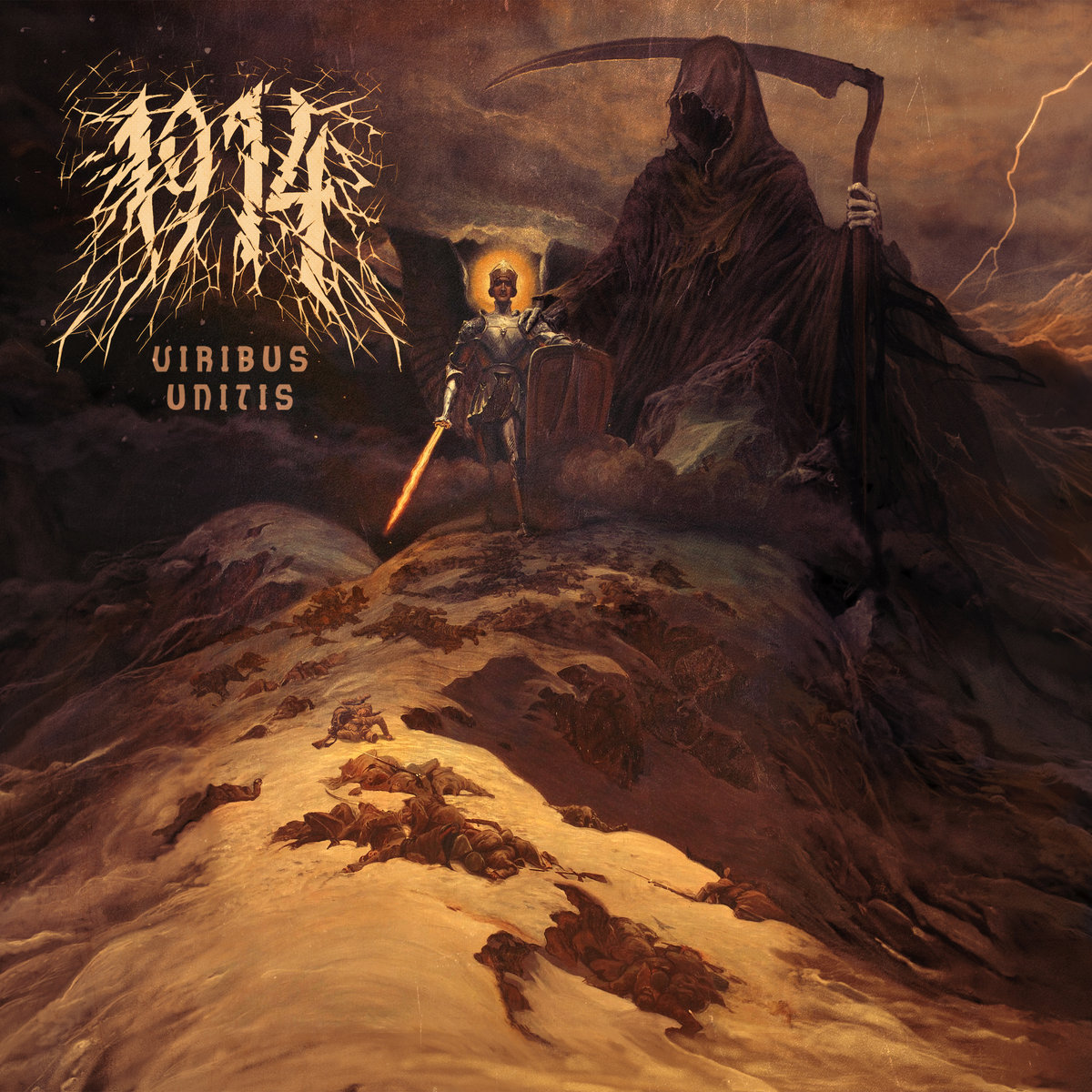
1914 – Viribus Unitis
Release Date: 14th November 2025
Label: Napalm Records
Bandcamp
Genre: Blackened Death Metal, Doom.
FFO: Kanonenfieber, Minenwerfer, Non est Deus.
Review By: Trina Julian Edwards
Ukrainian blackened death and doom metal visionaries, 1914, take us back to the front lines with their fourth album, Viribus Unitis, which is Latin for “With United Forces.” The album releases on Friday, November 14, via Napalm Records.
In Viribus Unitis, the personal accounts of a Ukrainian soldier in the K.u.K. army drive the narrative and show a subtle change in focus. From chronicling true stories of futility, destruction, and death, the band shifts to portraying themes that highlight brotherhood, fortitude, and survival after such horrific events. 1914 has always been able to enthral listeners with historically authentic, immersive, and harrowing accounts of war set to an appropriately brutal soundtrack. However, has the music changed with this change in focus? Let’s find out.
The album opens with War In (The Beginning of the Fall), a throwback to songs from the era, which will immediately transport the listener back to the early 1900s. We begin with 1914 (The Siege of Przemyśl), the longest siege in Europe during the war, during which Austria-Hungary’s forces were surrounded in the fortress city of Przemyśl for 6 months and 6 days before surrendering to the Russian Army. 1914 recounts the beginning of the siege, describing how the Russians hammered at the city for three days and accomplished nothing but the loss of 40,000 of their own soldiers. The tempo is livelier than one might expect from just the title. It’s more blackened death than doom, with a relentless rhythm echoing the hammering of the artillery and the endless gunfire of the initial skirmishes. The moving leads are manic but somehow still beautiful and melodic, and the dynamics infuse the track with the intensity and uncertainty of the earliest days of the siege. Kumarberg is in top form, speaking to the Austro-Hungarian defense, fiercely growling:
“…we filled the sky with shrapnel and death
Hold, breathe, aim
Shoot, reload, again
And we light up the night
With all our hate…”
It’s a beast of a song, absolutely crushing in its brutality and authentic storytelling. If you weren’t a fan before, you will be after this.
1915 (Easter Battle for the Zwinin Ridge) comes out swinging, describing how Austro-Hungarian forces took Zwinin Ridge from the Russians. It’s fast, it’s aggressive, and it doesn’t seem as if it’s planning on letting go. However, just after the 3:00 mark, it does. The tempo abruptly drops, allowing the guitars to take center stage. The speed then picks up again, with multiple voices singing/chanting in Ukrainian over the pounding rhythm. The lyrics are powerful, and there’s no doubt that many will feel a connection to current-day events:
“The thunder of cannons echoes through the valley
Throwing us into a bloody whirlwind
Rivers cry, mountains groan
Muscovites will die here
This is my land…”
(Muscovites is an old term for people from Moscow, or sometimes Russians in general.) This haunting refrain continues through to the end, and the a cappella vocals in the outro gave me goosebumps. At 9:15, the track is a bit long, but the dynamics do keep things from stalling too much, and it has a liturgical quality that makes sense in this context.
1916 (The Südtirol Offensive) opens with the sounds of gunfire, plunging listeners right into the heat of the battle of Asiago. The Austo-Hungarian troops initially succeeded in overtaking the Asiago plateau in Italy; however, weak and exhausted, their forces could not stand against the Italian counteroffensive, which forced the Austo-Hungarians to retreat. The blast beats are doing some heavy lifting here, driving the track continuously forward but never overpowering the rest of the instruments. There are some doomier sections in this track, adding to the oppressive atmosphere and foreshadowing the inevitability of an offensive that would leave hundreds of thousands dead or wounded with little ground to show for it. These blackened tremolos are incessant and inexorable, perfectly encapsulating the grinder of the unceasing war machine. The melodic leads are muted and mournful, playing beautifully off the harsh vocals lamenting the bitter reality of the losses.
1917 (The Isonzo Front) focuses on some of the bloodiest battles of the war. It consisted of 12 battles fought along the Isonzo River in Northeastern Italy. Italian and Austro-Hungarian forces fought from May 1915 to October 1917. Italy had been neutral until that point, but declared war on former allies in the hope of gaining territory. Historians believe there were around 1.7 million casualties. As the track opens, they refer to the Isonzo Front as “the river of grief and pain,” and at the very end, they call it “the river of death.” This is another fiery track, implacably burning through the verses as the narrative describes the advancing Austria-Hungarian forces. However, when the focus shifts from troop movements to bloody, personal combat, the tempo drops and the vocals drip with vitriol as Kumarberg describes dispatching his enemy. There are also some chunky riffs here that add some additional brutality to an equally brutal retelling. The tempo picks back up to earlier levels when the narrative returns to the campaign, separating the different aspects of the story. This is definitely another highlight of the album.
1918 Pt 1: WIA (Wounded in Action) likely refers to the second battle of the Piave River. A counterattack by the Italians against the Austro-Hungarians on June 19th, the date referenced in the song, resulted in heavy casualties and tens of thousands of captures. The track begins with another song from the era, its proud, upbeat melody putting anyone who reads the title of the track instantly on edge. The band’s entrance following that sinister opener is like a slap in the face. The difference in tone between the two is jarring, as I’m sure it was meant to be. The tempo is slower and more dirge-like, abrasively grinding away underneath Kumarberg’s vicious snarls. Even though the leads are not lacking in melody, the composition overwhelmingly imparts horror and desperation, and the tortured screams are absolutely terrifying. This is one of the more visceral tracks on the album. It was exceedingly well done and scary as hell.
1918 Pt 2: POW (Prisoner of War) features Christopher Scott of Precious Death. The soldier is telling his story of the disease, filth, and hard labor prisoners were subjected to in the different work camps where the Italians often kept Austro-Hungarian POWs. It’s fittingly more doom-like in many ways, typically slower than sludge but with plenty of aggressiveness in the rhythm and the riffs. The overall atmosphere, however, is suffocating, thick and heavy, like swimming through mud. The bleakness and despair in the vocals build on the crushing weight this track is laboring under. Scott’s unique vocals add another layer of sheer, morose hopelessness that speaks to the mindset of soldiers laboring in this man-made hell.
In 1918 Pt 3: ADE (A duty to escape), the soldier recounts escaping the POW camp with two others. We hear his inner monologue as they help one another survive, the soldier holding onto the one hope he has — to see his wife and daughter again. The ambient intro is eerie and unsettling, setting the tone for the track as it starts slow but builds in intensity and speed. Aaron Stainthorpe’s (High Parasite, formerly of My Dying Bride) evocative clean vocals detail the soldier’s thoughts, particularly highlighting his longing for his family, while Kumarberg’s growls spotlight their dangerous and desperate flight. It’s an excellent juxtaposition and an overall gorgeously woven composition that draws attention to the different aspects of the narrative without being heavy-handed.
The final composition from the band, 1919 (The Home Where I Died), is beautiful and heartbreaking. I knew from the first seconds of that warbly piano where this track was going. I’ll tell the world I very nearly cried my eyes out, and I’m not even sorry. It shows how successful they were at getting their message across. After all of the horror, blood, mud, and guts, the soldier is finally on his way home to embrace his family, but the war casts long shadows. He finds that while he was a prisoner, his city was taken by the Poles, and Kyiv is in danger from the Bolsheviks. The themes focus on the importance of holding family close, but also of duty, and how love also sometimes involves sacrifice “for our children… For our future…” Jérôme Reuter of Rome gives a masterful performance, infusing the lyrics with pathos without trying to oversell it. The last track, War Out (The End?) bookends the album with a return to the old-fashioned music of the era.
Overall, 1914, without a doubt, has not lost its edge on Viribus Unitis. The band’s ugly stories of war are just as authentically gut-wrenching and brutal as they ever were. However, this time, it’s the reminders of the resilience of the human spirit and our bonds with others that leave the biggest impression. The band still hammers the listener with the devastating blows of artillery fire, thunderous riffs, unstoppable tremolos, and savage vocals. Yet, they’ve expanded the listener’s auditory horizons with Viribus Unitis. The compositions feel more varied, the narrative is focused and fleshed out, and the execution is outstanding. My only tiny little gripe is that some of the compositions feel a bit longer than strictly necessary, but it’s a small price for my brain-fogged little behind to pay. 1914 has delivered what is their most impressive and likely most significant album to date.
 (4.5 / 5)

